
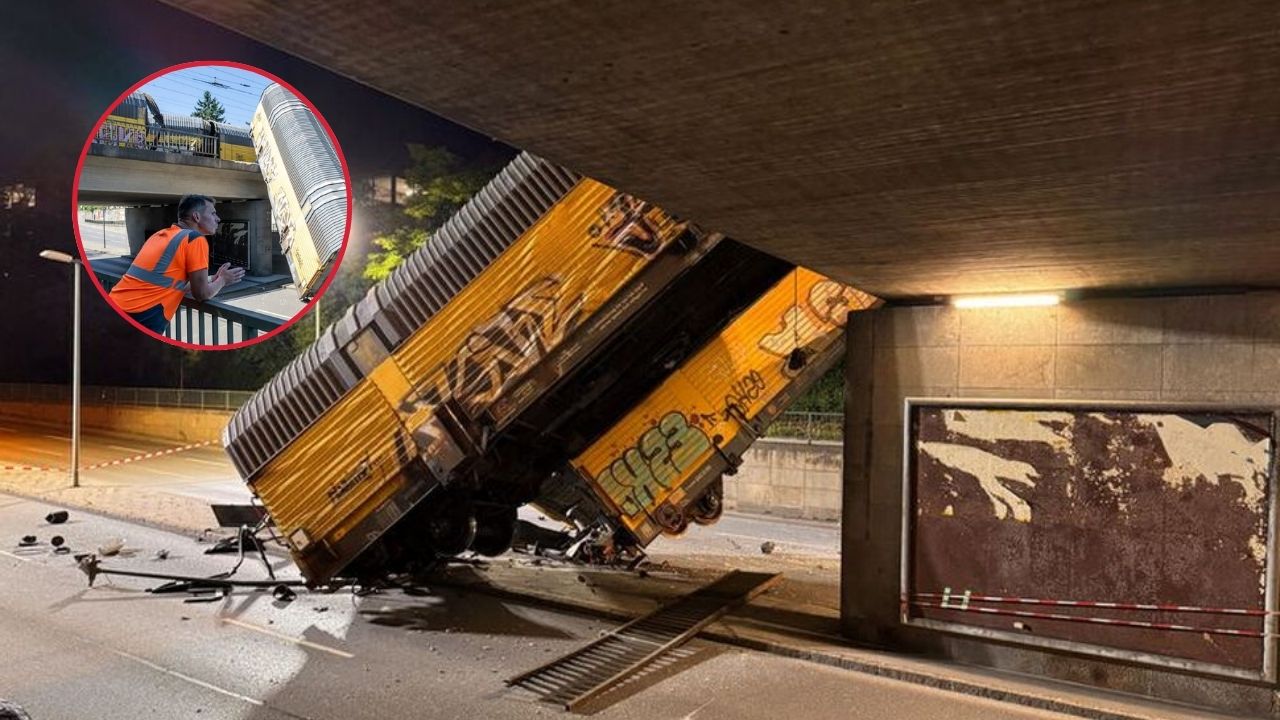
A fatal freight train accident in Munich, Germany, has prompted a major railway investigation after two cargo trains collided on an elevated rail line, sending derailed wagons crashing onto a roadway below. The incident claimed the life of a railway worker and caused extensive damage to vehicles beneath the bridge, though authorities say a larger disaster was narrowly avoided.
The collision occurred during overnight freight operations in Munich’s northern district of Milbertshofen, an area that serves as an important transportation and industrial hub. Emergency crews quickly responded to the scene, where twisted rail cars, scattered debris, and damaged vehicles created a complex recovery operation that lasted for hours.
Investigators are now working to determine exactly what caused the crash and whether any operational failures contributed to the deadly incident.
Collision Occurs During Freight Operations
The accident happened at approximately 1:40 a.m. while freight trains were engaged in shunting activities.
Shunting is a common railway procedure used to move, organize, and position rail cars within freight yards and cargo networks. Although these operations generally occur at lower speeds than mainline train travel, they still involve extremely heavy equipment and require precise coordination.
Authorities reported that two freight trains collided while operating on a dedicated cargo route in Milbertshofen.
The force of the impact caused portions of the trains to derail, creating a dangerous situation on the elevated railway structure.
Within moments, part of the freight consist left the tracks and began falling toward the road below.
Wagons Fall From Railway Bridge
One of the most dramatic aspects of the accident involved the derailment of two cargo wagons.
Following the collision, the rail cars were forced off the bridge and plunged approximately five meters, or about 16 feet, onto Schleißheimer Straße, a major roadway running beneath the rail line.
The heavy wagons slammed onto the asphalt below, scattering debris across the area and damaging nearby vehicles.
Photographs and videos from the scene showed rail cars hanging from the edge of the bridge while emergency responders secured the site.
The collapse created a significant hazard for traffic and required immediate intervention from rescue crews and railway officials.
Railway Worker Loses Life
Authorities confirmed that one railway worker died as a result of the accident.
The victim was reportedly involved in the shunting operation when the collision occurred. Emergency personnel located the worker at the scene, but officials determined that the injuries sustained were fatal.
No additional fatalities were reported.
The identity of the worker has not been widely released publicly as officials continue standard notification procedures and investigative reviews.
The death has deeply affected railway personnel and emergency responders who were called to the scene.
Investigators are expected to examine the worker’s role during the operation as part of the broader inquiry into the collision.
Vehicles Damaged by Falling Debris
Although no members of the public were injured, the derailment caused substantial property damage.
Authorities reported that falling debris and rail equipment struck several vehicles on Schleißheimer Straße.
A city bus traveling through the area sustained minor damage. Fortunately, the driver escaped injury, and the bus was not carrying passengers at the time of the incident.
Seven parked cars were also damaged when debris from the derailment landed on or near the vehicles.
Officials noted that the consequences could have been far more severe had the collision occurred during daylight hours when traffic volumes are significantly higher.
No Hazardous Cargo Involved
One of the first concerns following any freight train accident is the possibility of dangerous materials being released.
Railway officials quickly reassured the public that the derailed wagons were empty and not transporting hazardous substances.
According to Deutsche Bahn, Germany’s national railway operator, the cargo cars did not contain chemicals, fuels, or other dangerous goods that could have posed environmental or public health risks.
Because no hazardous materials were involved, emergency crews did not need to conduct evacuations or establish large exclusion zones.
This significantly simplified the response effort and reduced the potential danger to nearby residents.
Passenger Trains Continue Operating
Despite the dramatic nature of the accident, passenger rail services were not affected.
Authorities explained that the collision occurred on a freight-only section of track that is separate from routes used by commuter and long-distance passenger trains.
As a result, railway operators were able to maintain regular service schedules throughout the region.
Travelers using Munich’s passenger rail network experienced no major delays linked to the incident.
The separation between cargo and passenger infrastructure helped prevent broader transportation disruptions while recovery efforts continued at the crash site.
Massive Emergency Response Mobilized
The accident triggered a significant emergency response involving multiple agencies.
Approximately 60 first responders were dispatched to the scene, including firefighters, federal police officers, railway specialists, and technical rescue units.
Emergency crews immediately secured the area, assessed structural risks, and worked to protect motorists and pedestrians from additional hazards.
The presence of derailed rail cars suspended from the bridge required a highly coordinated operation.
Authorities established safety perimeters and closed access to the affected area while recovery plans were developed.
The operation remained active for several hours after the collision.
Major Road Closed During Recovery
Munich police ordered the complete closure of Schleißheimer Straße to facilitate rescue and recovery efforts.
Heavy-duty cranes were brought in to remove the damaged rail cars and clear debris from the roadway.
Lifting derailed train wagons from an elevated structure is a technically demanding process that requires careful engineering assessments.
Recovery teams worked slowly to avoid creating additional structural damage or causing further collapses.
Traffic diversions remained in effect while crews dismantled wreckage and restored safety to the area.
Authorities continued monitoring the bridge even after the damaged wagons were removed.
Investigation Focuses on Cause
Railway investigators have launched a comprehensive inquiry into the circumstances surrounding the crash.
A specialized rail accident expert has been assigned to analyze evidence, inspect damaged equipment, and review operational procedures.
Investigators are expected to examine train movement records, communication logs, maintenance histories, and safety protocols used during the shunting operation.
The goal is to determine exactly how the two freight trains came into contact and why the impact resulted in such a significant derailment.
Officials have not yet released preliminary findings or identified a probable cause.
Questions Remain After Deadly Crash
The Munich freight train collision has highlighted the risks associated with cargo rail operations, even in highly regulated transportation systems.
While Germany maintains one of Europe’s most advanced railway networks, accidents involving heavy freight equipment can still produce devastating consequences when something goes wrong.
The loss of a railway worker, combined with the dramatic bridge derailment, has placed renewed attention on safety procedures and operational oversight within freight transport systems.
As investigators continue their work, railway officials and transportation experts will closely review the findings to determine whether additional safety measures are needed.
For now, the focus remains on understanding what led to the fatal collision and ensuring that similar tragedies can be prevented in the future.