
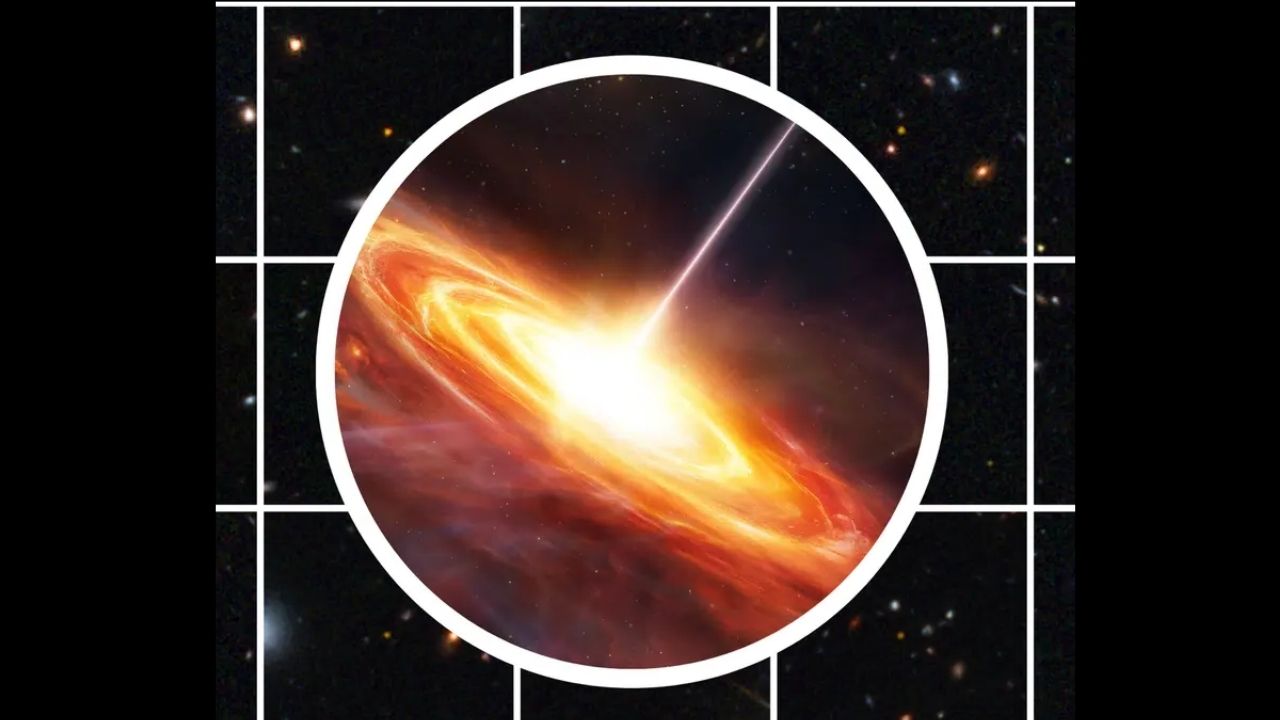
Astronomers have achieved a major milestone in the study of the early universe after the European Space Agency’s (ESA) Euclid space telescope identified 31 ancient quasars dating back to the universe’s earliest stages. The findings, published in a new scientific study, significantly expand the number of known quasars from this distant era and provide valuable clues about how supermassive black holes formed so quickly after the Big Bang.
Among the newly discovered objects are two of the oldest and most distant quasars ever observed. Scientists estimate these extraordinary cosmic structures already existed just 670 million years after the Big Bang, when the universe had reached only about five percent of its present age.
The discovery represents one of Euclid’s most impressive achievements since beginning scientific operations in 2023.
What Is a Quasar?
A quasar is one of the brightest objects in the universe. It forms when a supermassive black hole at the center of a young galaxy pulls in enormous amounts of surrounding gas and dust.
As this material spirals inward, it creates an extremely hot accretion disk that emits tremendous amounts of energy. Some quasars shine with the brightness of more than a trillion suns, making them visible across billions of light-years.
Although the black hole itself does not produce light, the rapidly rotating matter surrounding it creates the spectacular glow that astronomers detect with powerful telescopes.
Because quasars are so luminous, they act as cosmic beacons that allow scientists to observe regions of the universe that would otherwise remain hidden.
Euclid Changes the Search
Before Euclid entered service, locating ancient quasars required years of observations using ground-based telescopes.
Researchers explained that previous surveys took nearly a decade to identify only about ten quasars from this period of cosmic history. In contrast, Euclid discovered 31 during its first year of observations, demonstrating how dramatically the new observatory has improved the search process.
The telescope’s ability to scan vast regions of the sky while detecting extremely faint infrared light allows astronomers to locate distant objects far more efficiently than ever before.
This breakthrough is expected to accelerate discoveries throughout the remainder of the mission.
Mission Overview
The European Space Agency launched Euclid on July 1, 2023, aboard a SpaceX Falcon 9 rocket from Cape Canaveral.
The spacecraft now operates approximately 1.5 million kilometers from Earth at the Sun-Earth L2 Lagrange point, where it enjoys a stable environment for long-term observations.
Euclid’s primary mission is to investigate some of the biggest mysteries in cosmology, including dark matter and dark energy, while creating one of the most detailed three-dimensional maps of the universe ever produced.
Over the coming years, the mission aims to survey roughly one-third of the entire sky.
Looking Back in Time
The newly identified quasars belong to a period known as the Epoch of Reionization, one of the most important chapters in cosmic history.
Following the Big Bang, the universe experienced a long period often called the “cosmic dark ages.” During this time, stars and galaxies had not yet fully formed.
As the first generations of stars and galaxies emerged, they emitted enough radiation to transform the surrounding hydrogen gas from neutral to ionized. This transition gradually made the universe transparent to light and allowed galaxies to become visible across space.
By studying quasars from this era, astronomers can better understand how this transformation unfolded and how the earliest cosmic structures evolved.
A Scientific Puzzle
One of the biggest questions raised by the discovery concerns the incredible size of these early black holes.
Modern theories suggest that black holes require long periods of growth to reach billions of times the Sun’s mass. Yet these newly discovered quasars indicate that enormous black holes already existed less than one billion years after the Big Bang.
Scientists are still investigating how such rapid growth became possible.
Several explanations remain under consideration, including unusually massive seed black holes, accelerated growth through continuous matter accretion, or repeated mergers between young galaxies.
Each new discovery provides additional evidence that may help solve this long-standing mystery.
More Than Bright Lights
The importance of quasars extends well beyond the black holes themselves.
Because their brilliant light travels through billions of light-years of intergalactic gas before reaching Earth, astronomers can analyze that light to study the material lying between galaxies.
Every quasar effectively serves as a distant lighthouse, revealing details about the composition, temperature, and evolution of the early universe.
This makes quasars among the most valuable tools available for exploring the universe’s first billion years.
Working With Webb
The research team has already begun combining Euclid’s discoveries with observations from NASA’s James Webb Space Telescope.
While Euclid excels at finding rare objects across enormous areas of the sky, Webb provides much more detailed observations of individual targets.
Together, the two observatories create a powerful partnership.
Euclid identifies promising candidates, while Webb examines their structure, chemical composition, and surrounding galaxies in remarkable detail.
Scientists believe this combination will lead to even deeper insights into the formation of the earliest galaxies and supermassive black holes.
Why It Matters
The discovery of 31 ancient quasars more than doubles the known population from this crucial period in cosmic history. More importantly, it provides researchers with a much larger sample for testing theories about galaxy formation and black hole evolution.
Each newly identified quasar acts as a snapshot from billions of years ago, helping astronomers reconstruct events that shaped today’s universe.
As Euclid continues scanning larger portions of the sky, researchers expect many more distant quasars to emerge, creating the most complete census yet of these extraordinary objects.
With future observations from both Euclid and the James Webb Space Telescope, scientists hope to build a clearer picture of how the universe evolved from its earliest moments into the vast cosmic landscape we observe today.