
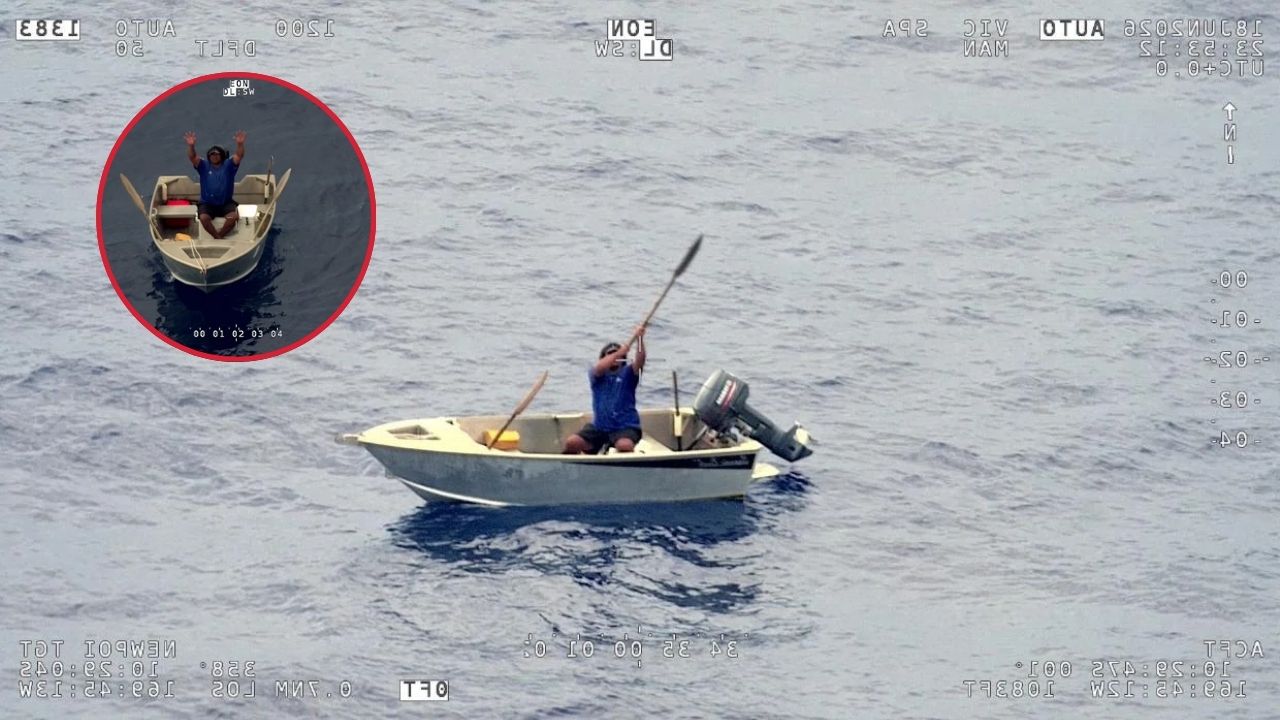
A dramatic search operation in the Cook Islands ended with a remarkable rescue after a fisherman who had been missing at sea for nearly a week was found alive drifting in a small aluminum boat in the Pacific Ocean.
The discovery was made by a Royal New Zealand Air Force (RNZAF) P-8A Poseidon aircraft during a large-scale search effort involving multiple agencies. The successful outcome has brought relief to the fisherman’s family and the remote island community that had feared the worst after days without contact.
Fishing Trip Turns Into Ordeal
The 42-year-old fisherman left Pukapuka Island on June 11 for what was expected to be a routine day of fishing. According to local reports, he was traveling alone in a 13-foot aluminum skiff and planned to return later that afternoon.
When he failed to arrive back by evening, concern quickly spread among relatives and residents. Local authorities were informed the following morning, triggering a search effort in the waters surrounding the northern Cook Islands.
As the days passed without any sign of the missing man, hopes began to fade. The vastness of the Pacific Ocean and the limited resources available on his small vessel made the situation increasingly dangerous.
Search Faces Major Challenges
The rescue effort encountered several obstacles from the beginning. Strong winds and rough sea conditions complicated local search operations and reduced visibility across large sections of the ocean.
The fisherman’s small boat also made aerial and maritime detection extremely difficult. Search teams had to cover a massive area of open water while working against changing weather conditions and ocean currents.
Officials were particularly concerned because reports suggested the fisherman had very little survival equipment on board. Without substantial food, water, communication devices, or emergency signaling equipment, his chances of enduring an extended period at sea appeared uncertain.
New Zealand Deploys Air Support
As the search entered its second week, New Zealand authorities stepped in to provide additional assistance.
The Maritime Rescue Coordination Centre requested support from the New Zealand Defence Force, which dispatched a P-8A Poseidon surveillance aircraft to assist in locating the missing fisherman.
The Poseidon is one of the region’s most advanced maritime patrol aircraft, capable of scanning vast ocean areas using sophisticated radar and surveillance systems. Its deployment significantly expanded the search capability available to rescue teams.
Crew members began systematic search patterns over remote waters surrounding Pukapuka, carefully examining large sections of ocean where the fisherman could have drifted.
Critical Sighting From the Air
The breakthrough came on the morning of June 19 when the RNZAF crew spotted a small vessel floating west of Pukapuka Island.
As the aircraft approached, observers noticed movement from the boat. The fisherman, who had spent days adrift, immediately reacted to the sight of the aircraft overhead.
Reports indicate he stood up and vigorously waved both his hands and an oar, signaling that he was alive and in need of assistance. The visual confirmation marked a crucial moment in the operation and transformed the search mission into a rescue effort.
Crew members maintained contact with the location while coordinating the next stage of the recovery.
Rescue Vessels Move In
Once the survivor’s position was confirmed, nearby commercial fishing vessels were alerted and directed toward the coordinates.
Because the Poseidon aircraft could not physically recover the fisherman, maritime assistance became essential. Commercial vessels operating in the region quickly altered course and headed toward the location identified by the aircrew.
The coordinated effort proved successful. The fisherman was safely brought aboard one of the responding vessels, ending a week-long struggle against the elements.
His rescue highlighted the importance of cooperation between military aircraft, rescue coordination centers, commercial ships, and local authorities.
Questions About Survival
One of the most remarkable aspects of the incident is how the fisherman managed to survive for so many days in a small open boat.
Although officials have not yet released full details about his condition or how he sustained himself, surviving a week in the open Pacific requires extraordinary endurance.
Exposure to intense sunlight, dehydration risks, changing weather, and physical exhaustion can quickly become life-threatening in such circumstances.
Many observers are now awaiting further information about the conditions he faced and the strategies he used to stay alive while drifting far from shore.
Relief Across Pukapuka
The rescue has generated widespread relief throughout Pukapuka, one of the Cook Islands’ most isolated communities.
Located more than a thousand kilometers northwest of Rarotonga, the island depends heavily on fishing and maritime activities. News of the fisherman’s disappearance deeply affected residents, many of whom know each other personally.
After days of uncertainty, confirmation that he had been found alive sparked celebrations and gratitude throughout the community.
For family members and friends, the rescue represents an outcome that seemed increasingly unlikely as each day passed.
A Rescue to Remember
The successful recovery serves as a powerful reminder of both the dangers faced by small-scale fishermen and the importance of coordinated search-and-rescue operations in the Pacific region.
Thanks to persistence, international cooperation, and a timely aerial sighting, a potentially tragic story ended with a survivor returning home.
As officials continue gathering details about the incident, the fisherman’s week-long battle for survival will likely be remembered as one of the most extraordinary rescue stories in the Cook Islands in recent years.