
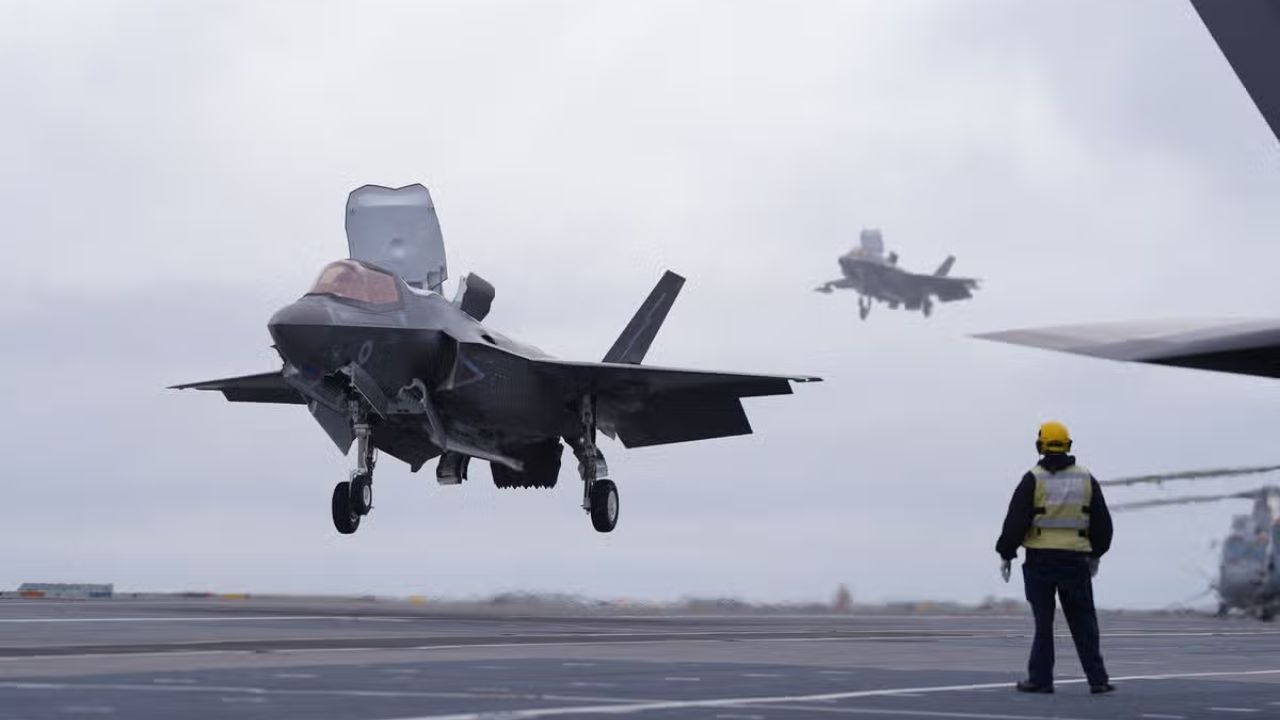
British fighter jets were launched from the Royal Navy aircraft carrier HMS Prince of Wales after a Russian maritime patrol aircraft approached a NATO carrier strike group operating in the Norwegian Sea. The encounter, confirmed by the UK Ministry of Defence, highlights the growing level of military activity in Northern Europe as NATO and Russia continue to closely monitor one another’s operations.
According to British officials, two Royal Air Force F-35 fighter jets intercepted the Russian aircraft after it repeatedly approached the multinational naval formation during ongoing NATO operations. The incident occurred while the carrier strike group was conducting its first NATO air policing mission linked to operations around Iceland.
Although no confrontation occurred, British authorities described the Russian aircraft’s actions as unsafe and said the fighters escorted it until it departed the area.
Mission Underway
The encounter took place while the UK’s Carrier Strike Group was participating in Operation Firecrest, a deployment focused on strengthening NATO’s presence across the North Atlantic and surrounding waters.
Led by HMS Prince of Wales, the strike group includes warships, aircraft, and personnel from several allied nations. The deployment is designed to improve interoperability among NATO members while demonstrating the alliance’s ability to operate across strategically important maritime regions.
British officials say the mission also supports NATO’s broader air policing responsibilities around Iceland and the northern Atlantic.
Russian Aircraft Approaches
According to the UK Ministry of Defence, the aircraft involved was a Russian Bear-F maritime patrol aircraft.
Officials stated that the aircraft made repeated approaches toward the carrier strike group while flying at relatively low altitude near HMS Prince of Wales.
The ministry also reported that the Russian aircraft released approximately ten sonobuoys into international waters during the encounter.
Sonobuoys are devices commonly used during anti-submarine warfare missions. Once deployed into the sea, they collect underwater acoustic information that helps detect and track submarine activity.
British officials criticized the aircraft’s proximity to the carrier during these maneuvers.
F-35 Response
Following the reported approaches, two British F-35 Lightning II fighter jets launched directly from HMS Prince of Wales.
The aircraft intercepted the Russian patrol plane and escorted it away from the carrier strike group until it left the immediate operating area.
Military intercepts of this nature are standard practice when unidentified or potentially concerning aircraft approach naval formations operating in international airspace.
The UK Ministry of Defence emphasized that the response was intended to ensure the security of personnel and equipment while maintaining safe operating conditions.
Why Sonobuoys Matter
One detail that attracted particular attention was the reported deployment of sonobuoys near the carrier group.
These floating sensors are routinely used by maritime patrol aircraft to monitor underwater activity, especially when searching for submarines. They transmit acoustic information to aircraft or command centers, allowing operators to identify underwater movements.
Although the deployment of sonobuoys in international waters is not unusual during military operations, British officials argued that releasing them in close proximity to the carrier strike group was unnecessary and inconsistent with professional operating standards.
Russia has not publicly commented on Britain’s description of the incident.
High-Level Visit
The reported encounter occurred during a visit to HMS Prince of Wales by UK Defence Secretary Dan Jarvis and Icelandic Foreign Minister Thorgerdur Katrin Gunnarsdottir.
The visit focused on reviewing NATO activities in the North Atlantic and discussing regional security cooperation.
British officials have increasingly emphasized the strategic importance of northern maritime routes, particularly as military activity across the Arctic and North Atlantic has expanded in recent years.
The presence of senior government officials aboard the flagship underscored the significance of the ongoing deployment.
Growing Security Concerns
Speaking during the visit, Defence Secretary Dan Jarvis highlighted the wide range of modern security challenges facing NATO.
He noted that potential threats extend across multiple domains, including maritime operations, aviation, cyberspace, outer space, and underwater infrastructure.
British defence planners continue investing heavily in carrier strike capabilities, advanced aircraft, intelligence systems, and multinational exercises to improve readiness alongside NATO allies.
Officials view these deployments as an important element of collective deterrence.
NATO’s Northern Focus
The North Atlantic and Norwegian Sea have become increasingly important areas for NATO planning.
These waters connect Europe with North America while also providing access to Arctic shipping routes and critical undersea communication infrastructure.
Iceland, although without a standing military, remains strategically important because of its geographic location between North America and Europe.
During the visit, Icelandic officials described the deployment as another example of NATO’s enhanced presence across the region and reaffirmed their country’s continued cooperation with alliance partners.
Looking Ahead
Military encounters between NATO aircraft and Russian patrol planes have become more common as both sides maintain an active presence in international airspace and surrounding waters. While these interactions typically conclude without escalation, they continue to highlight the importance of professional conduct, communication, and adherence to international aviation standards.
The latest interception involving HMS Prince of Wales demonstrates the Royal Navy’s readiness to respond quickly whenever aircraft approach its carrier strike group. As NATO continues expanding operations in the North Atlantic and Arctic regions, similar encounters are likely to remain a recurring feature of Europe’s evolving security environment.